

Two patients come to the clinic with the same prescription: -4.00 dioptres of myopia, -1.00 of astigmatism. If both undergo surgery using a conventional laser, the ablation profile applied to each eye is virtually identical. The system takes the spectacle prescription and removes the necessary corneal tissue to correct those dioptres. The same treatment for the same prescription. And in precision refractive surgery, that is a problem.
Because prescription strength is not the only factor that determines how well an eye sees. There are dozens of individual optical variables that no spectacle prescription takes into account, which vary from person to person, and which determine whether someone sees halos at night, experiences a loss of sharpness in low-light conditions, or perceives shadows around the edges of objects even with 20/20 vision when corrected.
Aberrometry, also known as wavefront analysis or wave tracing, maps these variables precisely. And the laser refractive surgery Based on this analysis, it can correct them individually for each eye, in each area of the cornea.
At Dr Ali Nowrouzi’s clinic in Marbella, this protocol forms part of the pre-operative assessment for LASIK, SMILE PRO and Trans PRK.
What does an aberrometry test measure, and why is your prescription not the whole story?
When the eye is not optically perfect, the light entering it does not converge at a precise point on the retina. It scatters, becomes distorted and is displaced. The result is a retinal image that is not as sharp as it should be. Aberrometry measures the extent and type of this dispersion.
Low-order aberrations: what a prescription does correct
Low-order aberrations include myopia, hyperopia and regular astigmatism. These are the defects corrected by a conventional spherocylindrical lens and are also treated by standard laser surgery. They account for the majority of refractive errors in quantitative terms, but do not, on their own, determine the final quality of vision.
High-order aberrations: what no conventional lens can correct
Higher-order aberrations (HOA) are more complex optical imperfections that have no equivalent in a spectacle prescription. There is no single lens that can correct them because they depend not only on the average curvature of the cornea, but also on every millimetre of its surface, the pupil diameter at that moment, and the ambient lighting. The main ones are:
Comma: It causes an asymmetrical distortion of the image, with a sort of tail or comet-like effect in one direction. It is the aberration that most significantly reduces visual quality in high myopia. It frequently occurs in off-centre ablations or in corneas with early-stage keratoconus. The patient reports seeing a bright spot as if it had a “tail” on one side.
Spherical aberration: This occurs when light rays passing through the edges of the pupil focus at a different point to the central rays. It is the most common type of HOA and is magnified in low-light conditions, when the pupil dilates. The direct consequence is concentric halos around headlights at night. Conventional LASIK, due to the geometric characteristics of the ablation process itself, tends to induce additional positive spherical aberration in short-sighted eyes.
Trefoil (clover): It creates a three-lobed pattern in the image of bright spots, like a three-pointed star. It frequently appears in corneas with irregular astigmatism or following surgery. The patient perceives it as three-dimensional star-shaped flashes around lights.
Tetrafoil and higher-order aberrations: less common, but clinically significant in corneas with irregularities, following previous surgery or in cases of very large scotopic pupilometry. Their impact increases significantly as the pupil dilates further.
Overall, HOAs typically account for only 10–20% of the total refractive error in terms of tissue volume, but they account for a significant proportion of the visual quality issues that spectacles cannot resolve.
Why pupil diameter makes all the difference
HOAs increase non-linearly with pupil diameter. An eye with moderate spherical aberration in daylight conditions, with a 3 mm pupil, can function perfectly well. That same eye in a dark tunnel, with the pupil dilated to 7 mm, perceives night-time halos very clearly.
This is why the pre-operative assessment always includes pupillometry in low-light conditions: the ablation zone must be large enough to cover the actual scotopic pupillary diameter, not just the photopic diameter under clinic lighting. Underestimating this factor is a common cause of suboptimal results in patients with large pupils who undergo surgery using standard ablation zones.
How the wavefront sensor works
The most commonly used system for analysing aberrations is the Hartmann-Shack sensor. It projects a low-power infrared light beam onto the retina and analyses the scattering pattern as the light exits the eye. The more irregular the eye’s optics, the more distorted this pattern becomes. Based on the dot pattern, the system calculates the Zernike coefficients: a set of standard mathematical polynomials that accurately describe each type of aberration.
The most advanced systems capture between 600 and 1,200 measurement points per eye, depending on the pupil diameter, producing a map with micrometre-level resolution of the entire functional optical surface. Some devices combine aberrometry, corneal topography, keratometry and pupillometry in a single scan, eliminating alignment errors between tests.
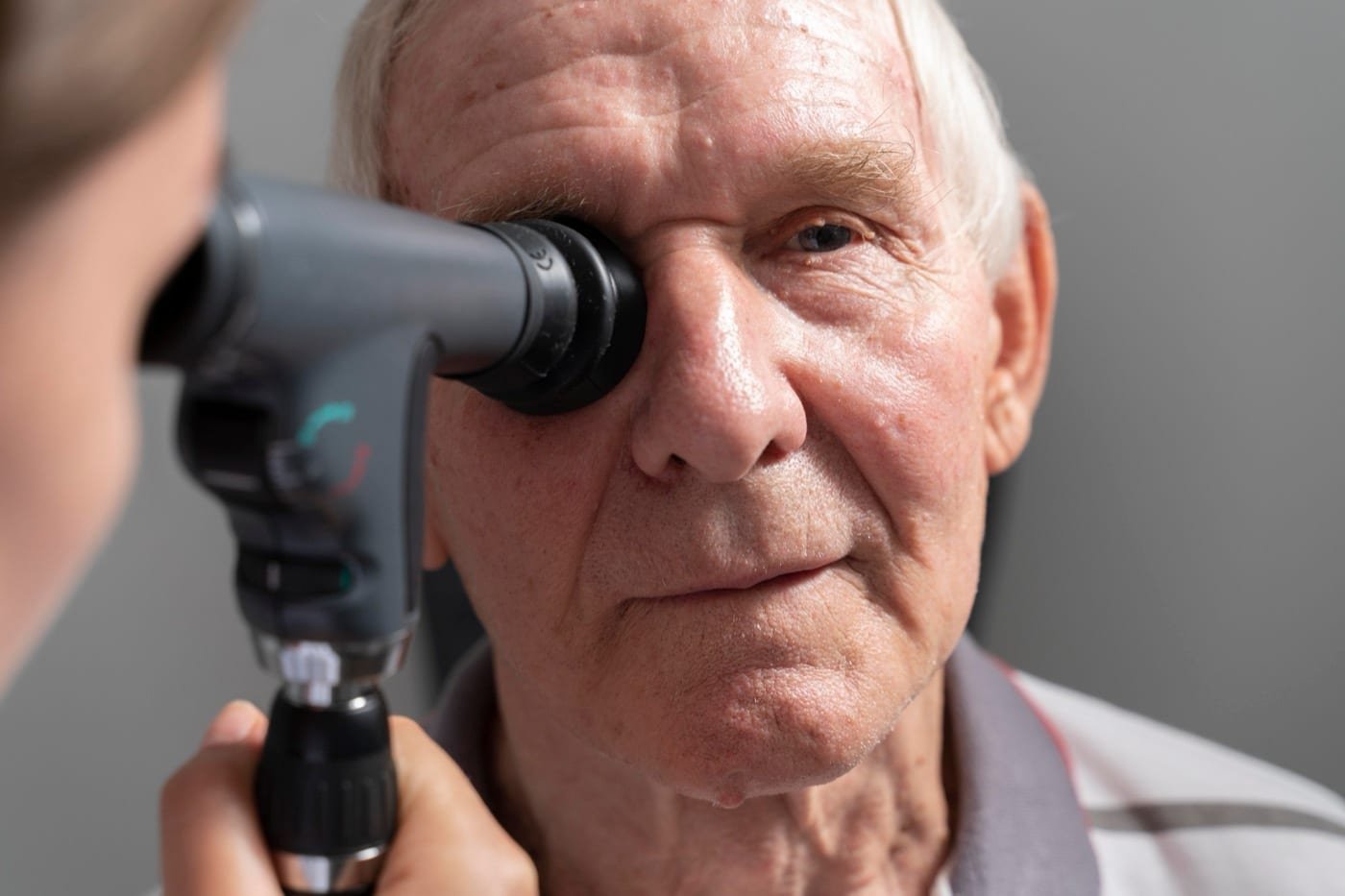
The examination is painless, takes between 5 and 10 minutes per eye and does not require pupil dilation in most cases.
The three types of laser profile: which one each eye chooses and why
This is where most patients do not receive enough information. There is no such thing as “one type of laser” for refractive surgery: there are at least three technical approaches to designing the ablation profile, each with different indications and different outcomes.
Wavefront-optimised (WFO) profile: the next-generation standard
The WFO profile does not use individual patient aberrometry to guide treatment. Instead, it applies a mathematical correction to the ablation profile based on statistical data from patient populations, in order to minimise the spherical aberration induced by the standard laser itself. It is an improvement on conventional laser treatment but is not a personalised treatment in the strict sense: all patients with the same prescription receive the same WFO profile.
It is the most commonly used profile in general refractive surgery and produces excellent results in most cases where pre-operative HOA values are low.
Topography-guided profile: when the cornea has irregularities
This profile uses a detailed topographical map of the corneal surface to plan the ablation. It does not measure the HOA of the entire optical system, but rather the geometric irregularity of the cornea. Its main advantage is its ability to treat irregular astigmatism, post-LASIK corneas with small ablation zones, and selected corneas with very early-stage keratoconus.
A study presented at the 2024 ASCRS Congress in Boston prospectively and randomly compared 120 patients: the group treated with topography-guided laser showed a lower prevalence of starbursts and greater satisfaction than the group treated with WFO using the same laser. Furthermore, in a comparative analysis published in *Ophthalmology and Therapy* (2024), a higher percentage of eyes treated with Contoura+Phorcides achieved 20/16 vision or better than those treated with WFO.
Wavefront-guided profile: complete customisation
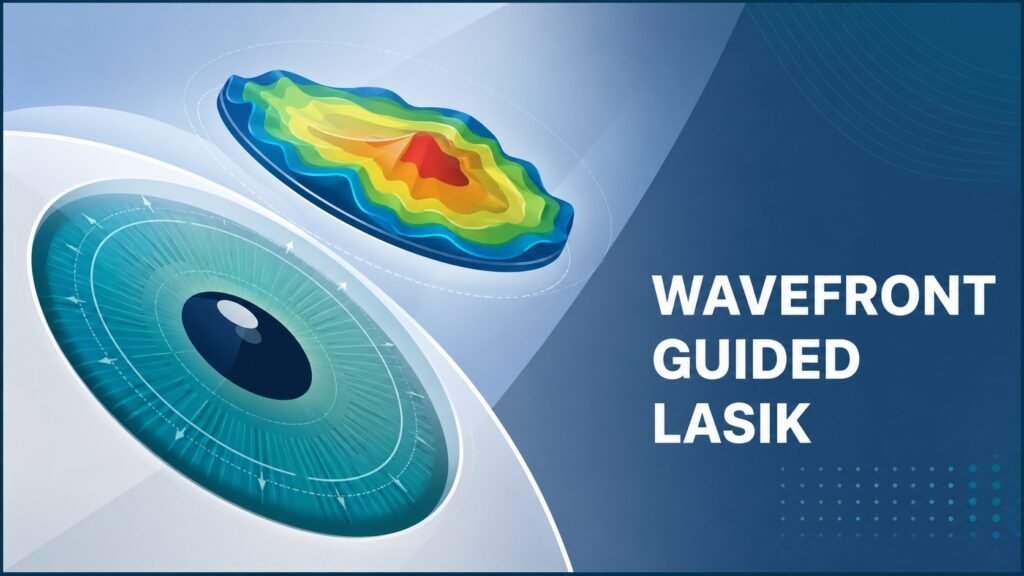
This is the most specific profile for each eye. It uses the patient’s individual aberration map – not statistical data or just the corneal surface – but the eye’s actual and complete optical behaviour. The excimer laser receives instructions zone by zone across the cornea to compensate for pre-existing HOAs and to design the ablation in such a way as to minimise those that the procedure itself may induce.
The ideal candidate for this procedure is a patient with moderate or high HOA values in the pre-operative assessment, a large scotopic pupil, or who has high visual demands: professional night-time driving, high-precision work, or competitive sport. For patients with low pre-operative HOA and no anatomical abnormalities, the outcome of the WFO or topography-guided profile may be clinically equivalent.
Which refractive techniques are compatible with aberrometry-guided surgery?
Wave tracing analysis is not limited to a single technique. It forms part of the diagnostic and planning protocol for the three main types of corneal refractive surgery. A more detailed article on the differences between these techniques is available at the refractive surgery blog of the consultation.
Wavefront-guided LASIK
The femtosecond laser It creates a millimetre-thick corneal flap with micrometre precision. The excimer laser then performs ablation beneath the flap, following a personalised profile derived from the aberrometry map. Visual recovery is rapid: most patients who undergo guided LASIK achieve functional vision within 24–48 hours. The optical outcome is particularly beneficial for those with moderate or high HOA.
One limitation of conventional LASIK is that the creation of the flap partially severes the superficial corneal nerves, which may temporarily exacerbate pre-existing dry eye. It is therefore essential to assess the condition of the ocular surface before surgery.
Aberrometry-guided Trans PRK
In Trans PRK, the excimer laser acts directly on the epithelial surface of the cornea without creating a flap. There is no cutting of the superficial corneal nerves at the same level as in LASIK, and the residual corneal biomechanics are more stable. It is the preferred technique for corneas of borderline thickness or when maximum safety is required in patients engaged in physical contact activities (athletes, law enforcement officers).
The aberrometry-guided profile is fully compatible with Trans PRK. Visual recovery is slower than with LASIK (3–7 days for functional vision, with vision stabilising completely within 1–3 months), but the long-term results are equivalent.
SMILE PRO and the preliminary analysis
SMILE PRO uses only a femtosecond laser to extract a lenticule of corneal tissue without the use of an excimer laser or a flap. The ablation profile has specific characteristics of the lenticule that are unique to this technique. In this case, aberrometry forms part of the preliminary diagnostic assessment to confirm the patient’s suitability and plan the procedure, alongside corneal topography and OCT. You can compare the differences between the techniques in detail in the article on What is refractive surgery and what options are available?.
Who benefits and who doesn’t?
Aberrometry analysis is particularly valuable in specific situations:
Patients with elevated pre-operative HOA values on the wave tracing map. Patients with a scotopic pupil diameter greater than 6.5 mm. Professional or night-time drivers, pilots, surgeons or those in occupations requiring high visual precision. Rescheduling of previous refractive surgery, where induced aberrations need to be corrected. Eyes with moderate irregular astigmatism that benefit most from topography-guided surgery or a combination of both analyses.
For patients with insufficient corneal thickness, very high myopia outside the safe range for ablation, or a corneal contraindication, Dr Nowrouzi considers the following as alternatives: ICL phakic lenses, which do not require the removal of corneal tissue. The article on dry eye after refractive surgery It is also important for understanding why the condition of the ocular surface prior to treatment may affect the indication.
What happens in the operating theatre during aberrometry-guided surgery
Iris recognition and pupil tracking: the key to accuracy
The aberrometry map is obtained whilst the patient is seated and the pupil is at a specific diameter. During surgery, the patient is lying down. When the head changes position, the eye may rotate slightly about its central axis, a phenomenon known as cyclotorsion. Even rotations of 2 degrees can misalign the ablation pattern and induce new aberrations, particularly in cases of astigmatism.
Iris registration automatically corrects this misalignment by comparing the image of the patient’s iris with the one obtained during the pre-operative examination. The system detects the unique patterns of the iris (much like a fingerprint), calculates the degree of cyclotorsion and realigns the ablation profile before firing the first pulse.
Active eye tracking, which is integrated into modern excimer lasers, compensates in real time for any eye movements during ablation. Current systems track the position of the eye at frequencies of between 500 and 1,000 Hz, adjusting the direction of each laser pulse with a latency of microseconds.
The combination of iris registration and active eye tracking eliminates most of the alignment error which, in previous systems, accounted for some of the sub-optimal results of laser-guided surgery.
The ablation process, step by step
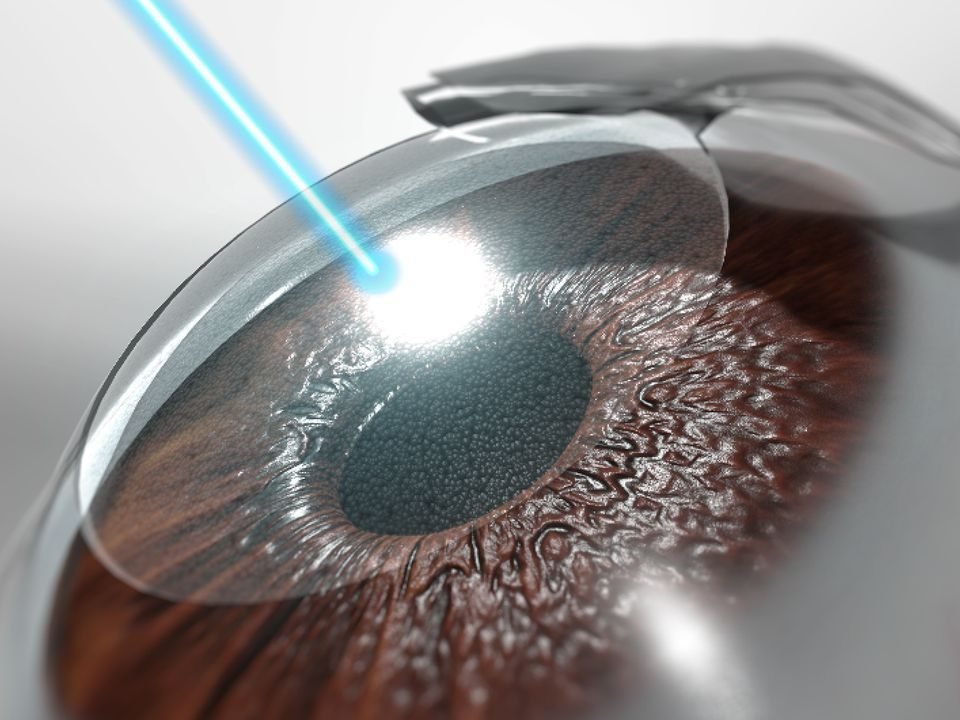
Once the flap has been created (in LASIK) or the epithelium removed (in Trans PRK), the excimer laser emits pulses of ultraviolet light at 193 nm. Each pulse removes a layer of corneal tissue with a precision of 0.25 micrometres per pulse. It is the spatial distribution of these pulses that differs between a standard profile and a guided profile: in the latter, the pulse density is higher in areas where the aberrometry map indicates greater irregularity, and lower where the cornea is already optically correct.
The total duration of the ablation depends on the diameter of the treatment area, the number of dioptres and the laser system used. With today’s high-repetition excimer lasers, a correction of -4.00 dioptres can be treated in less than 20 seconds of active ablation.
Following the repositioning of the flap or the application of the therapeutic dressing (on the surface), the eye regains its normal immune and epithelial function within hours (LASIK) or days (Trans PRK). The cornea is actively remodelling during the first few weeks, which explains the fluctuations in vision in the immediate post-operative period.
Clinical results: what the studies say
Visual acuity and refractive predictability
Studies using state-of-the-art topography-guided platforms show that 95–96% of treated eyes fall within ±0.50 dioptres of the target result, and that between 90 and 96% achieve 20/20 vision or better without correction at 12 months. In series using topography-guided procedures on eyes with myopia and astigmatism, a significant proportion achieve 20/16 vision, which is better than what is considered normal.
These figures are better than those for conventional laser treatment, particularly in the subgroup of patients with high pre-operative HOA or large pupils.
Night vision quality and reduction of photopsia
The prevalence of photopsic symptoms (halos, starbursts, glare, ghosting) is reduced in the groups treated with a personalised profile. The mechanism is straightforward: guided ablation compensates for the spherical aberration that conventional LASIK itself would induce, and in some patients it also reduces pre-existing spherical aberration.
Contrast sensitivity, measured using low spatial frequency optotypes and reduced light levels, improved statistically significantly in patients treated with WFG compared with those treated with WFO in the majority of comparative studies. This improvement is clinically relevant for night-time driving, where contrast between traffic signs, pedestrians and a dark background is the critical visual function.
Long-term stability
Corneal ablation is permanent. Most 5- and 10-year follow-up studies show minimal refractive regression (less than 0.50 D) in cases of low and moderate myopia. In cases of high myopia or thin corneas, regression may be greater and should be assessed preoperatively using corneal biomechanical analysis. The onset of presbyopia with age is independent of previous corneal surgery, as it is a process involving the lens rather than the cornea.
Dr Ali Nowrouzi’s pre-operative assessment protocol
The decision on whether surgery is indicated and the choice of ablation profile are not based on a single test. They are determined by reviewing the overall picture. Dr Nowrouzi, an FEBOS-CR-certified specialist (Fellow of the European Board of Ophthalmology – Refractive Surgery) and recognised in Top Doctors 2024, 2025 and 2026, has acted as a surgical demonstrator at ESCRS and ASCRS congresses and has over 100 publications in leading journals on refractive, corneal and lens surgery.
The pre-operative protocol at the Marbella clinic includes the following ocular diagnostic tests:
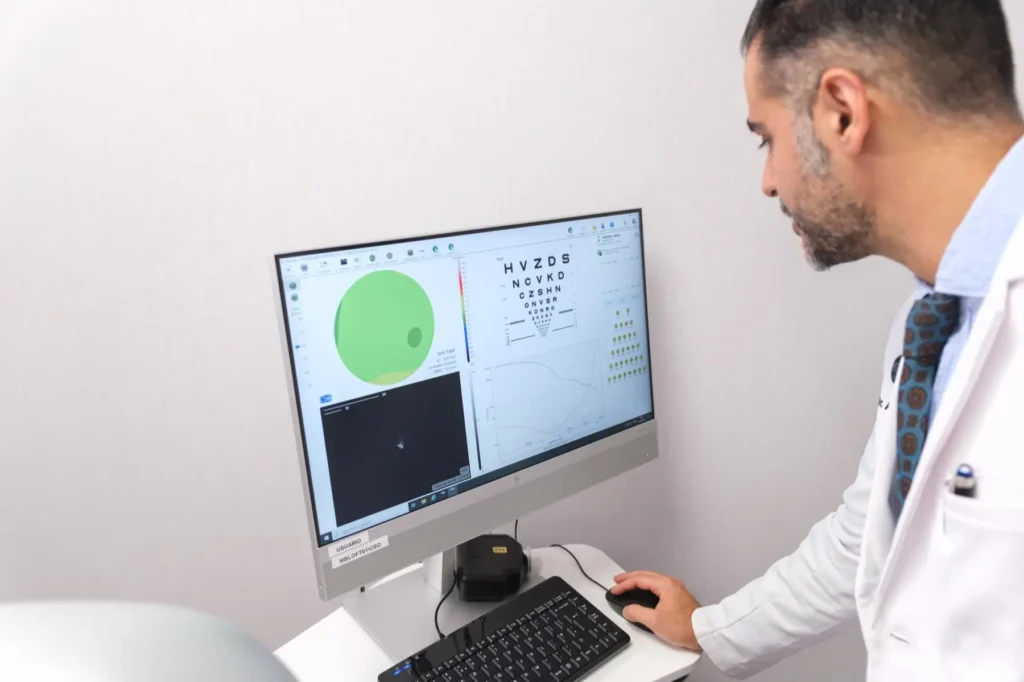
Comprehensive aberrometry (wave tracing): It quantifies the HOA for each eye, measures the actual scotopic pupil diameter and determines whether the wavefront-guided profile offers the expected clinical benefit over the WFO or the topographic profile.
Corneal topography: curvature, anterior and posterior elevation, and automatic analysis of subclinical keratoconus. The presence of patterns of incipient ectasia may contraindicate surgery, even if aberrometry and pachymetry results appear favourable.
Anterior segment OCT: It enables the measurement of stromal corneal thickness in the planned ablation zone, visualisation of the epithelial-stromal interface, and verification that the residual tissue will be sufficient to ensure long-term biomechanical stability.
Pachymetry: The minimum acceptable amount of post-operative residual stroma varies according to the biomechanical risk of each cornea, and is calculated individually for each patient based on the posterior elevation map and the biomechanical analysis.
Study of the ocular surface and dry eye: Uncontrolled dry eye can compromise aberrometry readings (an unstable tear film creates artificial aberrations) and worsen the post-operative outcome. Tear break-up time (TBUT), fluorescein staining and, in selected cases, meibography or OCT of the tear film are assessed. If significant dry eye is present, it is treated prior to surgery.
Scotopic pupillometry: The actual pupil diameter is measured in the dark to ensure that the treatment area covers it.
Cycloplegic refraction: In some cases, relaxing the ciliary muscle with cycloplegic eye drops makes it possible to determine the true prescription without the active accommodation component, thereby avoiding under- or over-correction.
If the comprehensive assessment shows that the patient is not a suitable candidate for surgery, they are informed of this before any procedure is proposed. If the cornea is insufficient, if there is subclinical keratoconus, if dry eye is severe and unresponsive to treatment, or if the biomechanical measurements raise concerns, the surgery is not performed. For these patients, alternatives such as ICL phakic lenses or, depending on their age and the condition of the lens, refractive lensectomy with a premium intraocular lens are discussed during the same consultation in the context of the cataract surgery.
Frequently asked questions about personalised refractive surgery using aberrometry
How does aberrometry and wavefront analysis differ from corneal topography? Topography measures the shape and curvature of the anterior surface of the cornea. Aberrometry measures how the eye’s entire optical system (cornea, lens and internal structures) distorts the wavefront of incoming light. They measure different things: topography provides information on geometry; aberrometry, on actual optical behaviour. The two are complementary and, in Dr Nowrouzi’s protocol, are carried out together.
Is the aberrometry-guided laser more expensive? In most centres, there is indeed a price difference compared with standard laser treatment, because the planning process and the equipment required are more specialised. The most important factor is not the absolute price, but whether the procedure is clinically indicated: not all patients benefit equally from aberrometric guidance. In eyes with low HOA, a well-executed WFO can yield clinically equivalent results.
Can I improve my vision even though I can already see well with glasses? Yes. Many patients with 20/20 vision with correction have high HOAs that no lens can correct. Guided surgery can reduce these aberrations, and the benefit is mainly noticeable in night-time driving, high-precision visual tasks and image quality in low-light conditions.
What happens if I have elevated HOA levels due to a previous operation? Older refractive surgeries, particularly conventional LASIK performed more than 10–15 years ago with small ablation zones, may have caused spherical aberration. Modern aberrometry accurately quantifies the extent of this aberration. In selected cases, profile-guided retreatment may improve residual visual quality, although suitability depends on the available corneal thickness.
Does wave tracing guarantee that I’ll be able to have the operation? No. The assessment determines whether the eye is a suitable candidate for surgery and which type of treatment is best suited to that eye. If the cornea is thin, if there is subclinical keratoconus, or if dry eye is severe, the procedure may be ruled out even if the aberrometric map is favourable.
Does aberrometry-guided surgery work for all degrees of short-sightedness? The best results are achieved in the range of -1.00 to -8.00 dioptres. Above this threshold, the amount of corneal tissue that needs to be removed increases significantly, and the biomechanical risk requires a more rigorous assessment. In cases of very high myopia, ICL phakic lenses generally offer a more favourable risk-benefit profile than corneal ablation.
How long does it take for vision to stabilise after surgery? With LASIK, most patients have functional vision within 24–48 hours and stable refraction after one month. With Trans PRK, epithelialisation and visual stabilisation take between 3 days and 4 weeks. Full refractive stabilisation usually occurs between 3 and 6 months. During this time, minor fluctuations in vision are normal and form part of the corneal healing process.
When is customised refractive laser treatment not recommended, and what would be the alternative? Laser treatment is not recommended if the residual corneal thickness following the planned ablation is insufficient, if there are signs of keratoconus (even if mild), if dry eye is severe and does not respond to treatment, or if the myopia is too high for safe ablation. In such cases, ICL phakic lenses or refractive lensectomy with a premium lens are the options to be considered during the same consultation.
Book an appointment for your personalised refractive assessment in Marbella
If you’ve been considering eye surgery and want to know whether an aberrometry-guided procedure is right for you, the first step is a comprehensive pre-operative assessment. No surgery, no obligations: simply a comprehensive assessment including all the tests described in this article, and honest clinical advice on which option is best suited to your eyes.
Dr Ali Nowrouzi carries out this assessment in Marbella, which includes wavefront analysis, topography, corneal OCT, scotopic pupillometry and a dry eye assessment.