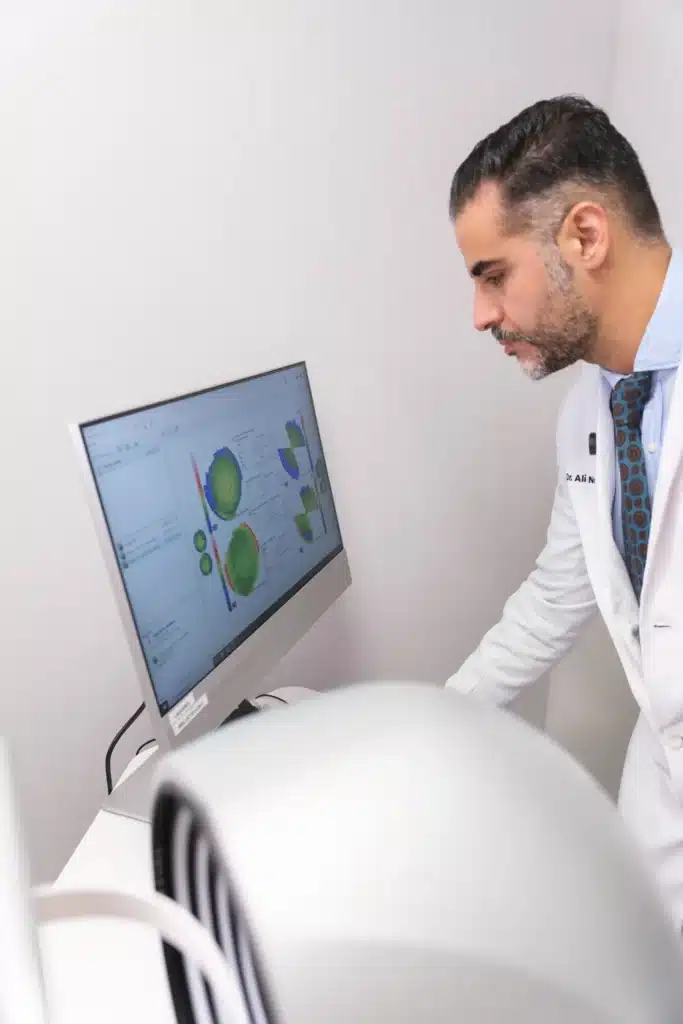
The corneal topography is an essential test to study the shape, curvature and regularity of the cornea. It can detect keratoconus, The aim is to assess irregularities that are imperceptible to the naked eye and to plan for any laser surgery in complete safety.
It is a test fast, non-invasive and non-contact, which generates a highly accurate three-dimensional map of the corneal surface.
At the clinic in Ali Nowrouzi we perform an advanced corneal study including:
Standard and non-invasive corneal topographyanalyses the corneal curvature and profile.
Rear topographydetects alterations on the inner surface of the cornea, a key factor in the early diagnosis of keratoconus.
3D Topographycreates three-dimensional models for customised refractive surgeries.
Epithelial mapshows fine irregularities of the corneal epithelium, useful in early keratoconus and unexplained corneal pain.
This study is essential in patients who wish to undergo laser surgery, in cases of high myopia or astigmatism, and in the assessment of corneas with previous alterations.
Topography shows what the cornea looks like at each point: whether it is regular, whether it has more curved or flat areas, whether there is a tendency to deformation or whether it shows initial signs of keratoconus.
It is the most reliable tool for detecting disturbances before they affect vision.
Topography is the first safety filter to find out whether a patient can be operated on.
It confirms that the cornea is stable, sufficiently thick and without signs of deformity.
Laser surgery should never be carried out without recent topography.
If in doubt, it is complemented by:
Pachymetry (corneal thickness)
Aberrometry (optical quality)
Yes, in fact, it is the proof more sensitive to detect it, even when vision is still good.
Posterior topography and epithelial mapping can identify very early keratoconus, subclinical stages or suspicious corneas.
No. The corneal topography is entirely non-invasive y contactless.
It only requires you to fix your gaze for a few seconds while the equipment captures the image.
Visit 1 and 2 minutes per eye.
The results appear immediately and are explained during the same visit.
Yes. Topography helps to detect undiagnosed astigmatism and to assess whether an astigmatised toric or premium lens is right for you.
In these cases it is combined with ocular biometry.
The topography analyses the form of the cornea.
The pachymetry measures its thickness.
The two complement each other to assess corneal health as a whole.
If you need a corneal topography or wish to assess whether you can safely undergo laser surgery, you can book an appointment with Dr. Ali Nowrouzi in Marbella and perform the test at the same appointment, with detailed interpretation on the spot.